Rediscover the Way Back to Yourself

How do you feel today?
Perhaps you notice tension that won't release. A mind that won't quiet. Sleep that doesn't restore. A sense that something is missing — not from your life, but from yourself.
If any of this feels familiar, you are not alone. The nervous system was never designed for the pace most of us keep.
Eventually, the body stops coping quietly and starts communicating loudly. The body is not malfunctioning — it is communicating. And what it asks for is simple: stop. Be still. Listen.
Everything changes when we choose and learn to hear them.
The Rediscover Method™
Backed by science. Grounded in ancient wisdom. Guided by you.
Every session at Rediscover Wellness is a practice in nervous system regulation — guided by The Rediscover Method™, a cyclical approach rooted in both modern science and ancient wisdom.
It is not a programme you complete. It is a practice you deepen. Each cycle returns you to the beginning — but you are never quite the same person who started.

HeartMath Heart Rate Variability (HRV) biofeedback, conscious breathwork, and sound healing with multiple instruments are tools we use.
In personal sessions, we begin by measuring your HRV which reflects how adaptable and resilient your nervous system is at that moment. This involves five to ten minutes of natural breathing and using a HeartMath emWave sensor — a small earlobe clip connected to a laptop. The results appear as a real-time graph.
We take another reading at the end. What this gives you is not just a felt sense of having shifted — it is visible, objective evidence that your nervous system responded. You don't just feel the difference. You see it.
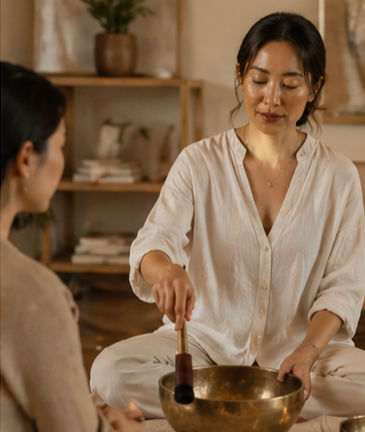
It is important to note that sound healing is not always gentle. Some of what we work with — gongs, drums, deep resonant frequencies — can be physically powerful. But this is precisely the point. When sound fills the space completely, the thinking mind has nowhere to go. The internal noise quiets. And in that stillness — even within the sound — the body can finally be heard.

How can this help you?
This can help if you want...
01.
...a genuine rest to address tension that won't release; sleep that doesn't restore; a nervous system that has forgotten how to switch off from all the pressure at home, school or work.
Rediscover a body that knows how to settle. The relief of carrying less.
→ Physical dimension
03.
…mental clarity and resilience because you lead a team or spend most of your time where pressure is constant. Cognitive overload, decision fatigue, running on stress rather than genuine energy.
Rediscover a way to stay focused and calm. In all situations.
→ Performance dimension
05.
…a shared experience of presence with a partner, a close friend, or a small group of people who matter to you.
Rediscover connection that happens in the body before it happens in words.
→ Relational dimension
02.
…to feel safe and supported because you are moving through something heavy. Grief, anxiety, a season of change, or the weight of too much feeling for too long.
Rediscover the peace and strength you didn't know was still there. A way back to yourself.
→ Mental & Emotional dimension
04.
…a real relationship with your inner world because you have done the surface work and are ready to go deeper. Beyond relaxation. Into something more meaningful, more inward, more true.
Rediscover the stillness with depth. The beginning of the inward journey.
→ Spiritual dimension
Not sure which of these is you? That is fine too. Simply Rediscover is an open door — no experience, no self-diagnosis, no agenda required. Just come.
If you prefer a personalized experience, you can register for a trial session for Rediscover Flow.
Start anywhere.
Every journey through Rediscover Wellness starts with a single, unhurried step.
You don't need to know exactly what you need. You just need to begin.
Private and Group Sessions
- 65 Singapore dollars
- Read More
For individuals seeking a personal, practitioner-assessed session to calm and reset your system
1 hr 30 min
From 180 Singapore dollars 1 hr 30 min
From 200 Singapore dollars1 hr 30 min
From 360 Singapore dollars
Corporate Sessions
2 hr
From 1,000 Singapore dollars
The story behind this
Hi, my name is Gillian and I'm glad to have you here.
I spent nearly two decades working in the corporate world. On the outside, I looked like I was doing well. A stable career, a recognisable title, the kind of life that looks right from the outside. On the inside, I was slowly losing touch with who I really was. I didn’t realise I was dysregulated—I just thought I needed to cope better.
I kept doing what was expected. I held everything together, smiled when I wasn't okay, and ignored every signal my body was sending me. I chased the traditional markers of success — not because they were mine, but because I had not yet stopped long enough to ask what was. I was seeking acceptance in a language that was never really my own.
Maybe you have felt this too. Tired to your bones, yet still carrying on — because you don't know how to stop, or because stopping feels like failing, or because the life you have built doesn't leave much room for the question: is this really how I want to live?
One day, that question found me anyway.
I didn't arrive at it easily. I arrived at it at the edge of burnout, after years of pushing through the signs my body had been offering — the tension, the restlessness, the sleep that never quite restored me, the quiet but persistent sense that something important was missing. Not from my life. From myself.
That question — is this how I want to live for the rest of my life? — changed everything.
I began to slow down. To create space for the answers to appear. To be quiet enough to listen. I was searching — not for more achievement or external validation, but for something more authentic within myself. I wanted my life to have meaning. I wanted to use my time, my energy, and my heart to genuinely help others. I wanted to stop performing and start living.
What brought me back was a combination of science and ancient wisdom — the profound effect of sound on the nervous system, the quiet power of conscious breath, and the simple but radical act of learning to be still. These were not quick fixes. They were a return — to my body, to my own voice, to the life that had been waiting for me beneath all the noise.
I chose the word rediscover because I believe our bodies and hearts already know what we need. The wisdom is not missing. But when life is too loud, too fast, and too heavy, we stop hearing it. We stop listening. We stop caring for ourselves in the ways that actually matter.
I know this — because I lived it.
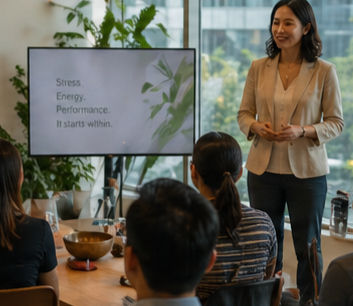
Exactly because I've lived the pace, now I hold the space for others who are ready to make that return. I work with individuals who are burnt out, emotionally exhausted, or simply ready for something more. I work with teams and leaders who are running on stress and deserve something better. And I work with people who cannot quite name what they need — only that something needs to change.
You don't need to arrive knowing what you need. You don't need a diagnosis or a reason or the right words. You just need to arrive and show up for yourself.
The body is not malfunctioning — it is communicating. And what it is asking for, more than anything, is this: to stop, to be still, and to listen.
That is what Rediscover Wellness is for.
Let's rediscover, together.
Gillian Tan
Founder, Rediscover Wellness
HeartMath certified · Sound Healing Academy certified ·
Yoga 200 hours YTT · Functional Range Conditioning (FRC) trained ·
Continuing education in TCM, somatic therapy & kinesiology
__________________
Gillian is the founder of Rediscover Wellness and creator of The Rediscover Method™.
Her foundational training includes HeartMath biofeedback, sound healing, 200-hour Yoga Teacher Training, and Functional Range Conditioning — forming the integrated, body-science understanding from which her nervous system regulation practice is built. She is currently deepening her studies in TCM principles, somatic therapy, and kinesiology.

Your questions answered
01.
What actually happens in a session?
Each session begins with a brief check-in — how you are feeling, what is present for you today. In personal sessions, an HRV reading is taken first: a small sensor on your earlobe tracks your heart rate variability for 5–10 minutes while you breathe naturally. This gives us an objective baseline of your nervous system's current state.
From there, you settle into a comfortable position — usually lying down — and sound takes over. Tibetan singing bowls, gongs, tuning forks, drums, and other instruments are played around you, at varying distances and intensities. Breathwork may be woven in. You do not need to do anything except receive.
At the end, a second HRV reading shows the shift that has occurred — visible, objective, and often surprising. A brief debrief follows at whatever depth feels right.
No experience is required. Just come in comfortable clothing that you can lie down in. Nothing else is asked of you except to arrive.
02.
Do I need to believe in sound healing — or follow a particular religion — for this to work?
Not at all. The effects of sound and breathwork on the nervous system are physiological — your body responds to frequency and vibration regardless of what you believe about it. There is no faith required, no worldview to adopt, and no spiritual framework imposed on any session.
Rediscover Wellness is not affiliated with any religion or spiritual tradition. People of all faiths and beliefs (or none) attend sessions here and have all found value in this work, precisely because it does not ask you to adopt anything. It simply creates the conditions for your nervous system to do what it already knows how to do.
Some instruments — Tibetan singing bowls, for example — have historical roots in certain cultural traditions. At Rediscover Wellness, they are used purely for their acoustic and therapeutic properties. There is no ritual, no prayer, and no invocation in any session.
The HRV data tends to speak for itself. Sceptics are genuinely welcome.
If you have specific concerns about how this sits alongside your personal faith, feel free to reach out before booking — a brief conversation can address anything that feels uncertain.
03.
Is it ok if I fall asleep?
Yes — completely. If your body chooses sleep, that is your nervous system doing exactly what it needs to do. The sound vibrations continue to work whether you are awake or not. Every cell in your body receives them regardless of your state of consciousness. Falling asleep is not a sign that you missed the session — it is often a sign that your body finally felt safe enough to let go. Many people find it one of the deepest rests they have had in a long time.
04.
Is it ok if I cry or feel difficult emotions?
Not only is it okay — it is welcome. Sound therapy is not solely about relaxation. It is also about release. Emotions that have been sitting beneath the surface — sometimes for a very long time — often find their way out when the body finally feels safe and still enough to let them move.
This is a safe space. There is no correct way to experience a session, and there is nothing to be embarrassed about. Whatever arises is simply what was ready to be released — and releasing it is the work. What no longer serves you needs somewhere to go, so that what you actually need can take its place. You will never be rushed through an emotional response.
05.
What if my experience is completely different from what I expected or what others told me?
Good. There is no standard experience in this work. Some people feel deeply peaceful. Some feel nothing at all in the moment and notice the shift only hours later — in how they sleep, how they respond, how they carry themselves. Some feel emotions move through them. Some find unexpected clarity. Some simply feel that something, somewhere, has loosened. Whatever you experience is yours. It is not wrong, it is not a failure, and it does not need to match anyone else's account.
06.
What is HRV and why does it matter — especially in Singapore?
Heart Rate Variability is the variation in time between your heartbeats. A higher HRV indicates greater heart-brain coherence — a more adaptable, resilient nervous system that can shift efficiently between activation and rest. A lower HRV indicates a system under chronic stress, struggling to recover.
In Singapore, where fast-paced work culture and chronic stress are common, understanding your HRV can help you take control of your heart health, mental wellness, and overall performance. HRV is not just a wellness trend — it is a physiological marker that gives real insight into how your nervous system is actually functioning day to day.
HRV can reveal if chronic stress is taking a toll on your heart, gauge exercise readiness and recovery, assess sleep quality, and predict long-term health outcomes — with studies linking low HRV to diabetes, hypertension, and poor cardiovascular outcomes.
Importantly, HRV is not just relevant to elite athletes or those with heart conditions. A peer-reviewed study examining HRV norms specifically in a Singapore population — measuring over 2,100 participants — found that overall HRV declines with age, with the sharpest decline occurring in the 50s age range. For professionals in Singapore's high-demand work environment, this makes monitoring and actively supporting HRV particularly relevant — and particularly timely.
At Rediscover Wellness, HRV is measured using a HeartMath emWave sensor before and after every personal session. The reading takes 5–10 minutes and requires nothing except sitting still and breathing naturally. A second reading at the end of the session shows — visibly, objectively — the shift that has occurred in your nervous system. You don't just feel the difference. You see it.
Further reading:
-
Health365 Singapore — Heart Rate Variability: What It Means and Why It Matters in Singapore: health365.sg/heart-rate-variability-test-why-it-matters-and-what-your-numbers-mean
-
The Pulse of Singapore: Short-Term HRV Norms — peer-reviewed study of 2,143 Singapore participants. Applied Psychophysiology and Biofeedback (2023): link.springer.com/article/10.1007/s10484-023-09603-4
-
HeartMath Institute — Science of the Heart (300+ peer-reviewed studies): heartmath.org/science
-
McCraty, R. & Shaffer, F. (2015). Heart Rate Variability: New Perspectives on Physiological Mechanisms. Global Advances in Health and Medicine: pubmed.ncbi.nlm.nih.gov/25694852
-
Shaffer, F. & Ginsberg, J.P. (2017). An Overview of Heart Rate Variability Metrics and Norms. Frontiers in Public Health: frontiersin.org/articles/10.3389/fpubh.2017.00258
-
NHS Centre for Integrative Care — uses both HeartMath and music therapy as part of clinical care: nhsggc.scot/hospitals-services/main-hospitals/gartnavel-general-hospital/nhs-centre-for-integrative-care
07.
Is there scientific evidence behind breathwork?
Yes — and it is some of the most well-established science in the nervous system field. Conscious, controlled breathing directly activates the parasympathetic nervous system — the branch responsible for rest, recovery, and regulation — via the vagus nerve. This is not alternative medicine. It is mainstream physiology.
Slow, rhythmic breathing patterns (typically around 5–6 breaths per minute) have been shown to increase HRV, reduce cortisol, lower blood pressure, and improve emotional regulation. This breathing rate — sometimes called resonance frequency breathing or coherent breathing — is what the HeartMath emWave tracks and encourages during HRV assessment, and it is woven into sessions at Rediscover Wellness as both a standalone practice and a complement to sound therapy.
Research and further reading:
-
Zaccaro, A. et al. (2018). How Breath-Control Can Change Your Life: A Systematic Review on Psycho-Physiological Correlates of Slow Breathing. Frontiers in Human Neuroscience. frontiersin.org/articles/10.3389/fnhum.2018.00353
-
Jerath, R. et al. (2015). Self-Regulation of Breathing as a Primary Treatment for Anxiety. Applied Psychophysiology and Biofeedback. link.springer.com/article/10.1007/s10484-015-9279-8
-
Laborde, S. et al. (2017). Heart Rate Variability and Cardiac Vagal Tone in Psychophysiological Research. Frontiers in Psychology. frontiersin.org/articles/10.3389/fpsyg.2017.00213
-
Kox, M. et al. (2014). Voluntary activation of the sympathetic nervous system and attenuation of the innate immune response in humans. PNAS. pnas.org/doi/10.1073/pnas.1322174111 (Wim Hof method study — demonstrates voluntary nervous system influence through breath)
-
HeartMath Institute — The Quick Coherence Technique: heartmath.org/resources/heartmath-tools/quick-coherence-technique-for-adults
08.
Is there scientific evidence behind sound healing — and is it used in reputable institutions?
Yes. Sound therapy has moved well beyond the fringes of alternative medicine and is now used in some of the world's most respected medical institutions.
Cleveland Clinic and Memorial Sloan Kettering Cancer Center — two of the world's leading hospitals — both offer sound and music therapy as part of their integrative medicine and cancer care programmes. The NHS Centre for Integrative Care in Glasgow offers both HeartMath and music therapy as part of its clinical programme for patients with long-term conditions. NASA researchers are also exploring how sound therapy could help astronauts regulate stress, improve sleep, and support recovery during space travel.
On the research side, a neurophysiological study measuring EEG brainwaves and HRV during a singing bowl session found effects consistent with a shift toward a more meditative state, with participants reporting measurable improvements in wellbeing. A randomised controlled trial found that vibroacoustic therapy — which uses sound vibrations in the same frequency range as Tibetan singing bowls and tuning forks — significantly increased HRV and reduced stress and muscle tension. Decades of peer-reviewed studies have confirmed that sound produces measurable changes in the brain and body that go beyond simple relaxation.
At Rediscover Wellness, HRV biofeedback before and after every personal session provides your own real-time evidence of the shift. The science is not abstract — it shows up in your data.
Further reading:
-
Goldsby et al. (2017) — Singing Bowl Sound Meditation study: pmc.ncbi.nlm.nih.gov/articles/PMC5871151
-
Singing bowls systematic review (2025): pmc.ncbi.nlm.nih.gov/articles/PMC12063014
-
Cleveland Clinic Music Therapy: my.clevelandclinic.org/departments/cancer/patient-education/music-therapy
-
Memorial Sloan Kettering — Music Therapy: mskcc.org/cancer-care/diagnosis-treatment/symptom-management/integrative-medicine/mind-body/music-therapy
-
NHS Centre for Integrative Care: nhsggc.scot/hospitals-services/main-hospitals/gartnavel-general-hospital/nhs-centre-for-integrative-care
-
Sound Healing Research Foundation: soundhealingresearch.org
09.
What is the HeartMath Institute and why do you use their approach?
The HeartMath Institute is an internationally recognised non-profit research and education organisation founded in 1991. Over three decades, they have published more than 300 peer-reviewed studies on the relationship between heart rate variability, emotional regulation, cognitive performance, and overall wellbeing.
Their emWave biofeedback technology — which is used in sessions at Rediscover Wellness — has been validated in clinical, corporate, educational, and military settings worldwide.
HeartMath's core insight is that the heart and brain are in constant two-way communication, and that the coherence between them — measured through HRV — has profound effects on how we think, feel, and perform.
When heart-brain coherence is high, the nervous system is regulated, emotional responses are proportionate, and cognitive function improves. When coherence is low — as it tends to be under chronic stress — the opposite is true.
Using HeartMath alongside sound therapy and breathwork allows us to measure what is often only felt — and to show you, in real time, that the shift is happening.
Learn more:
-
HeartMath Institute: heartmath.org
-
Science of the Heart — full research overview: heartmath.org/science
-
emWave technology overview: heartmath.com/emwave-pro
-
McCraty, R. (2016). Science of the Heart, Volume 2. HeartMath Institute. heartmath.org/research/science-of-the-heart
10.
What is the difference between Simply Rediscover, Flow, and Harmony?
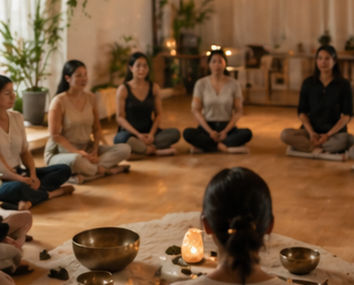
Simply Rediscover is an open group session — the most accessible way to experience the work for the first time, or to return to regularly as a practice. No booking of a specific series required.
Rediscover Flow is a personal 1:1 session tailored to what you need on that particular day, including HRV biofeedback. It is practitioner-assessed from the start — you don't need to know what you need before you arrive.
Rediscover Harmony is a committed programme of minimum 4 sessions, building progressively across your chosen dimensions of wellness. Each session is informed by the last, and HRV data is tracked across the full programme.
If you are unsure, begin with Simply Rediscover. The work itself will show you where to go next.